A Space Station Falls Toward Earth the Entire Time It Orbits. Here Is Why It Never Lands.
The station falls around Earth forever, and NASA's own numbers — about 250 miles up, 17,500 miles per hour, gravity still at 88.8 percent of its ground strength — explain both the endless fall and the pushes that repair it.
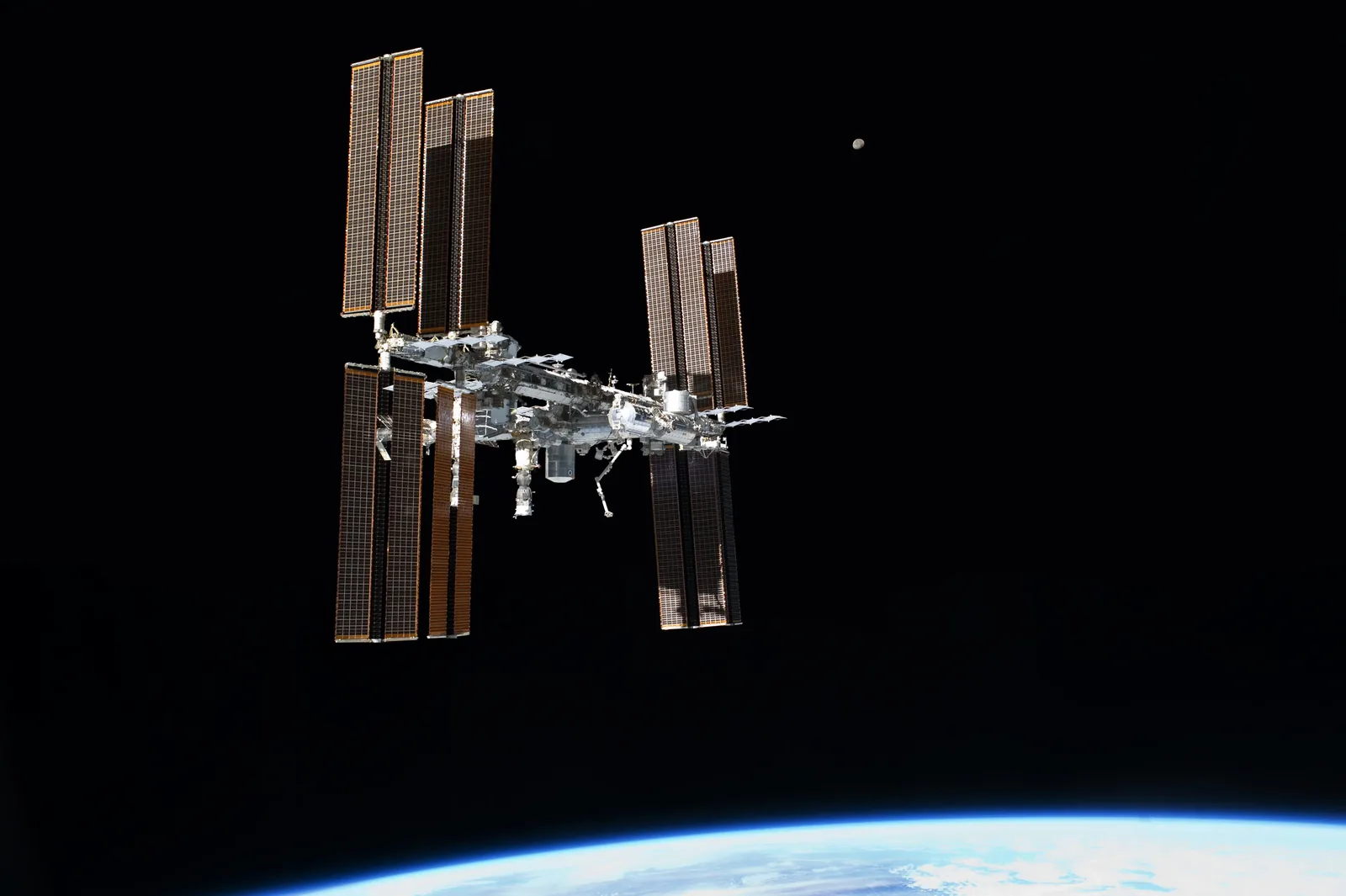
The International Space Station crosses the sky about 250 miles above your head, and nothing about its flight involves floating free of gravity. Gravity pulls on the station the whole time. The station falls toward Earth right now, and the fall never pauses for a single minute of a single orbit. The station never lands because the fall runs sideways as well as down: at 17,500 miles per hour, the curve of the fall matches the curve of Earth, so the ground drops away beneath the station as fast as the station falls toward the ground.
NASA states the result in one phrase: the orbiting laboratory continuously falls around Earth in a nearly perfect circle. The crew float for the same reason. An astronaut, an apple and the station all fall together at the same rate, so nothing inside presses down on anything else, and loose objects hang in the air. NASA calls the condition microgravity, and the name matters: gravity up there runs strong, and free fall, not absent gravity, does the work.
The station falls around Earth, and falling around Earth keeps the station in orbit
A dropped object on Earth falls straight down and lands. A thrown object falls along a curve and lands farther away. An object thrown fast enough falls along a curve that never meets the ground, because Earth curves away under the fall. Orbit names that third case. The station lives in the third case permanently, circling Earth about every 90 minutes while the fall continues underneath every mile of the trip.
Gravity at the station's altitude still reaches 88.8 percent of its strength on the ground
Plenty of readers assume the station escaped gravity somewhere on the way up. NASA's numbers say otherwise. Earth's gravitational field at about 250 miles above the surface holds 88.8 percent of its strength at the surface, and NASA's classroom explainer puts the same fact in kitchen-table terms: a person who weighs 100 pounds on the ground would weigh 90 pounds at the station's height of about 200 to 250 miles. Gravity does far more than linger up there. Gravity holds the station in orbit, because a station free of any pull would travel in a straight line and leave Earth behind for good.
A cannonball fired fast enough from a mountaintop falls around Earth instead of landing
Isaac Newton worked the trick out more than 300 years ago, and NASA still teaches his thought experiment. Picture a cannon on top of a very tall mountain. A gentle shot arcs down and lands nearby. A harder shot travels farther before landing. A shot fired at exactly the right speed falls along a curve matching Earth's own curve, and the cannonball never lands at all. NASA calls that state continuous free fall around Earth, and the state carries a shorter name: orbit.
The station obeys the same balance. NASA's orbit explainer describes a constant tug-of-war between a satellite's momentum — the tendency of a moving object to keep moving in a straight line — and gravity pulling the satellite back toward Earth. Too little forward momentum, and the object gets pulled down and crashes. Too much, and the object speeds past without entering orbit. Balanced, the object always falls toward the planet, and sideways speed fast enough means the fall never reaches the planet.
A speed of 17,500 miles per hour matches the curve of the station's fall to the curve of Earth
For the station, the matching speed runs 17,500 miles per hour, or 28,000 kilometres per hour. Scale helps here: at that speed, the station covers a distance equal to its own 250-mile altitude in under a minute, and the full trip around Earth takes about 90 minutes. The number never came from a throttle setting anyone chose for drama. Altitude sets the number. Fly lower and an orbit demands more speed; fly higher and an orbit demands less. NASA gives the comparison directly: at 150 miles above Earth, orbital velocity runs about 17,000 miles per hour, and satellites in higher orbits carry slower orbital velocities.
The clock confirms the speed. NASA's research overview gives one orbit every 90 minutes and 16 sunrises and sunsets per day for the crew. NASA's station orbit tutorial adds the range the altitude produces: each orbit takes 90 to 93 minutes depending on the station's exact altitude, for about 16 orbits a day, generally 15.5 to 15.9.
Thin air drags on the station, and the station's altitude drops gradually over time
Space at the station's height still counts as atmosphere, barely. NASA describes the orbiting laboratory's location as the upper edge of Earth's atmosphere, and traces of air at that height drag on the station as the station flies through them. The drag stays tiny on any single pass, and the drag also never switches off. NASA's orbit tutorial states the outcome without decoration: the station's orbital altitude drops gradually over time due to Earth's gravitational pull and atmospheric drag, and as the altitude decays, the station's orbit tracks on the ground change slightly.
That gradual drop has a name: orbit decay. Decay differs from the fall this piece opened with. The orbital fall curves around Earth and sustains the flight; decay shaves the flight down, lowering the whole orbit a little at a time until the orbit needs repair. Nothing dramatic marks the change from one week to the next. The repair schedule, rather than any single alarming moment, tells the story.
Reboosts push the station back up, and a docked Dragon spacecraft performed six reboosts on one stay
The repair carries its own name: a reboost. A docked spacecraft fires its engines and pushes the entire station back up to a higher orbit, restoring the altitude drag took away. NASA's tutorial sums the cycle up in a clause — periodic reboosts adjust the station's orbit — and NASA's station blog supplies a fresh count. The SpaceX Dragon spacecraft that undocked on February 26, 2026, after arriving the previous August, performed six reboosts during its stay, five in 2025 and a final maneuver on January 23, 2026. NASA describes that reboost work as helping maintain the station's altitude and counter atmospheric drag, and calls the work critical for safe operations and the long-term sustainability of the orbital complex.
Two facts, held together, explain the whole flight. The station falls toward Earth without pause, at a sideways speed that bends the fall around the planet instead of into the planet. The same station also loses altitude to thin air the whole time, so docked spacecraft keep pushing the orbit back up. Falling never threatened the station. Falling, done at 17,500 miles per hour, runs the entire method — and a reader who wants the arithmetic behind speeds and altitudes like these will find the working on CalculateMine's converters, linked below.
Sources
- NASA, "Why Do Research On The International Space Station?" (published July 24, 2022; updated Sept. 29, 2023) — the station 400 kilometres (250 miles) above Earth at 17,500 miles per hour, orbiting every 90 minutes, 16 sunrises and sunsets per day; the orbiting laboratory "continuously falls around the Earth in a nearly perfect circle"; the station's location at the upper edge of Earth's atmosphere. NOTE: this page prints the speed as "36,000 kilometers (17,500 miles) per hour" — an internal inconsistency; the piece prints the kilometres figure from the Glenn and classroom pages (28,000 km/h) instead. https://www.nasa.gov/missions/station/iss-research/why-do-research-on-the-international-space-station/ — opened in full.
- NASA Glenn Research Center, "What is Microgravity?" (Feb. 13, 2009; updated July 25, 2023) — Earth's gravitational field at about 250 miles above the surface at 88.8 percent of its surface strength; typical orbital altitudes for human spaceflight of 120–360 miles; Newton's cannon thought experiment; continuous free fall around Earth as orbit; orbital speed of the space station at 17,500 miles per hour (28,000 km per hour); the apple, the astronaut and the station all falling together. https://www.nasa.gov/centers-and-facilities/glenn/what-is-microgravity/ — opened in full.
- NASA, "What Is Microgravity? (Grades K-4)" (published March 30, 2010; updated March 28, 2025) — the station orbits at about 200 to 250 miles high; a person who weighs 100 pounds on the ground would weigh 90 pounds there; a spacecraft in orbit moves at the right speed so the curve of its fall matches the curve of Earth, and for the station that speed is 17,500 miles per hour. https://www.nasa.gov/learning-resources/for-kids-and-students/what-is-microgravity-grades-k-4/ — opened in full.
- NASA, "What Is an Orbit? (Grades 5-8)" (published July 7, 2010; updated April 1, 2025) — Newton's first law and the tug-of-war between momentum and gravity; too little momentum and the object is pulled down and crashes, too much and it speeds past; orbital velocity defined as the speed needed to stay in orbit; at 150 miles (242 kilometres) above Earth, orbital velocity is about 17,000 miles per hour, and higher orbits have slower orbital velocities; one complete orbit in low Earth orbit takes about 90 minutes. https://www.nasa.gov/learning-resources/for-kids-and-students/what-is-an-orbit-grades-5-8/ — opened in full.
- NASA Johnson Space Center, Earth Sciences and Image Analysis, "orbit Tutorial" (Cynthia A. Evans and Julie A. Robinson) — each ISS orbit takes 90–93 minutes depending on exact altitude; about 16 orbits per day, generally 15.5 to 15.9; the ISS orbital altitude drops gradually over time due to Earth's gravitational pull and atmospheric drag; periodic reboosts adjust the ISS orbit; as the altitude decays, the orbit tracks on Earth change slightly. https://esrs.jsc.nasa.gov/Tools/orbitTutorial.htm — opened in full.
- NASA space station blog, "Dragon Splashes Down and Returns Science, Cargo" (Mark A. Garcia, Feb. 27, 2026) — the Dragon spacecraft undocked Feb. 26, 2026, after arriving Aug. 25, 2025; during its time docked, Dragon performed six reboosts, five in 2025 and a final maneuver on Jan. 23, helping maintain the station's altitude and counter atmospheric drag, critical for safe operations and the long-term sustainability of the orbital complex. https://www.nasa.gov/blogs/spacestation/2026/02/27/dragon-splashes-down-and-returns-science-cargo/ — opened in full.
 Next in this issue · TechStory County, Iowa Put Up $100,000 and Brought In More Than $10 Million to Wire Its Rural Homes →
THE MOTHER LODE — Edition Nº 004 · Late — Suite Picks. Photos are real, licensed and credited on the page; designed cards carry figures from the article itself.